Dive Brief:
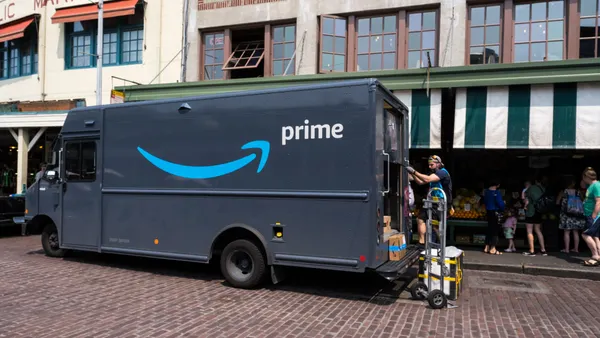
- Amazon projects the percentage of its U.S. packages delivered via the company's own logistics network will reach over 86% next year as it reduces reliance on other parcel carriers, according to a Sept. 3 report from Business Insider citing an internal Amazon planning document. In 2023, the company said over two-thirds of its packages were delivered this way.
- The percentage is projected to climb to nearly 89% in 2029, per the report. Amazon also estimates it will shrink its share of packages delivered by the U.S. Postal Service and UPS from 10% and 1.8%, respectively, in 2027 to 8% and 1.4% in 2029, according to the report.
- In response to a request for comment about the report, Amazon spokesperson Steve Kelly said in a statement to Supply Chain Dive that the company is always planning and forecasting across its operations. "Any internal projections are preliminary, subject to significant revision, and should not be treated as definitive or as representing finalized plans.”
Dive Insight:
Amazon's heavy investments into its last-mile delivery network are clearing a path for the company to bring more packages to customers' doorsteps without another parcel carrier’s network. Last year, the e-commerce giant announced a $4-billion investment to expand its shipping capabilities, tripling its rural delivery network's size by the end of 2026.
The rural delivery investment signaled to the wider parcel market that Amazon was going to reduce its dependence on third parties as it pushed to accelerate shipping speeds, said Mark Waverek, managing partner at PlaidMark Management Consulting Services, in an interview with Supply Chain Dive. Amazon said in 2025 that the spending would lead to less populated areas receiving coverage from more than 200 delivery stations, which prepare shipments for the final leg of delivery.
"These are not big high-volume markets, but they're allowing customers to put their product closer to the end consumers," Waverek said.
In the process, Amazon's reliance on other U.S. parcel carriers is shrinking. The company cut the volume delivered by UPS in half and scaled-back delivery agreement with the Postal Service this year. Amazon will still need to make handoffs to the Postal Service in certain instances of far-flung deliveries, Waverek said.
"They're only going to give the Post Office the stuff that they just can't do, and there's certainly a lot of ZIP Codes," Waverek said.
Amazon already established itself as the top U.S. parcel carrier by volume last year with 6.7 billion packages delivered through its logistics arm, outpacing the Postal Service’s 6.6 billion packages and UPS’ 4.4 billion packages, ShipMatrix reported in March. This year, Amazon has pursued further volume growth for its U.S. delivery offering — Amazon Shipping — through competitive pricing offers versus FedEx and UPS.