Dive Brief:
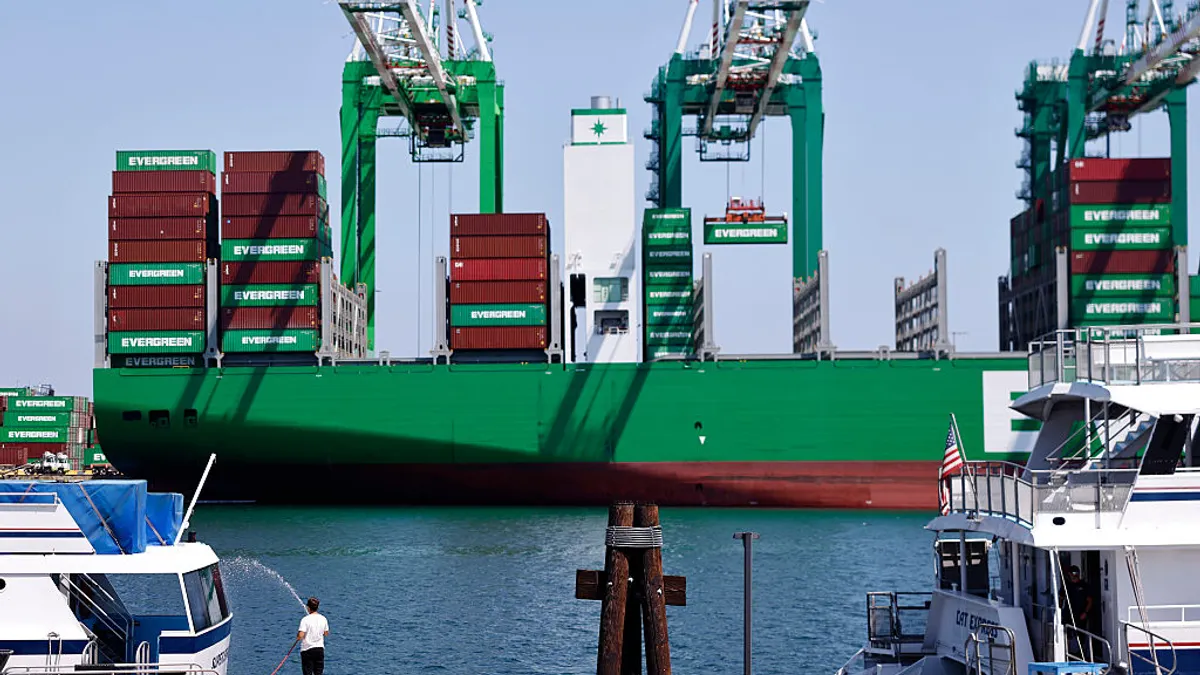
- With blanked sailings outpacing capacity growth, ocean shippers could be facing a market with less space to book their cargo, according to Sea-Intelligence’s Blank Sailings tracker from July 24.
- Despite injecting new capacity into the market, ocean carriers have increased blank sailings by up to 4.5 times higher to execute tighter supply control during the first half of 2026 compared to the same period in 2019, per Sea-Intelligence.
- The research, data and advisory firm found that although scheduled capacity grew by 46%, blank sailings grew by 215% in the Asia-to-U.S. East Coast trade lane during the first half of 2026 compared to the first half of 2019. While West Coast capacity grew 16%, blanked sailings went up 62%.
Dive Insight:
Even with more market capacity, shippers still face the risk of having less vessel space onboard ships to book their cargo.
For shippers, this could mean "rolled cargo, longer lead times, less schedule reliability and, if enough capacity gets pulled, upward pressure on freight rates," Pete Mento, a director with Baker Tilly’s Global Trade Management Services, told Supply Chain Dive.
One distinction with added market capacity is the difference between physical capacity and available capacity.
"A carrier can own plenty of ships and still reduce the capacity actually offered on a trade lane through blank sailings, slower sailing speeds, vessel redeployment or service changes," Mento said.
The headache for shippers is that cargo doesn’t disappear just because the sailing does. “It gets pushed onto the next available vessels, so you can suddenly have several weeks of demand fighting over one week’s worth of space,” Mento said.
As a consequence, shippers can no longer rely on pre-pandemic supply models, per Sea-Intelligence, and must readjust their minimum thresholds and adapt their allocation strategies.
Mento explained that pre-pandemic supply models were more predictable.
“Procurement teams could make assumptions about how long it would take to move a container from Asia to the United States and be reasonably confident they were in the ballpark,” he said.
Interestingly, transportation networks may be drifting towards pre-pandemic capacity conditions, Mento said, but not entirely.
“Companies are much more conscious of resilience, alternate sourcing, inventory buffers and geopolitical risk than they were in 2019.”