A growing number of fashion brands are consolidating existing sourcing bases, opting to work with fewer but more capable vendors over the next two years, according to a 2026 Fashion Industry Benchmarking Study published by the U.S. Fashion Industry Association.
As part of a “new phase of sourcing strategy,” 30 U.S. fashion companies surveyed between April and June 2026 are adjusting their tactics due to ongoing trade and tariff uncertainty, per the study published in partnership with Sheng Lu, professor and director of graduate studies in the Department of Fashion and Apparel Studies at the University of Delaware.
Because U.S. tariffs will continue to have an impact on cost, “the goal is to maintain geographic diversity while consolidating sourcing networks to work more closely with key strategic partners overseas that offer sourcing flexibility and strong compliance,” USFIA President Julia Hughes said in a foreword.
Compared to 2025 statistics, substantially fewer brands plan to source from additional companies or expand their vendor network over the next two years, per the study. This means that instead of pushing rapid geographic expansion and diversification, some brands are prioritizing capacity, flexibility, inventory agility and regional balance.
For instance, last year Nike said it was negotiating with retail partners and suppliers to offset tariffs, among other actions. Ralph Lauren, meanwhile, said it would work closely with its suppliers to adjust production levels to countries with lower U.S. tariff rates. PVH Corp., which owns Calvin Klein and Tommy Hilfiger, last year outlined efforts to work with vendors and its supply base to curb tariffs.
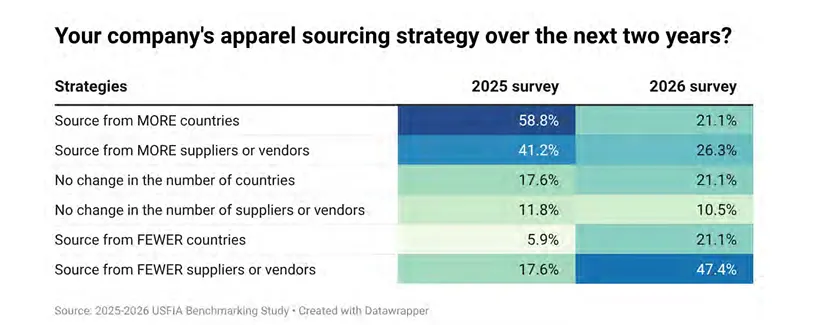
Only about 21% of survey respondents plan to source goods from more countries through 2027 — a significant drop from nearly 59% in 2025. About 26% of surveyed brands plan to source apparel from more suppliers or vendors, down from 41% the year prior.
Meanwhile, nearly half of respondents plan to source from fewer suppliers over the next two years, which is almost three times the share reported in 2025.
According to selected comments, some survey respondents said they are consolidating to fewer vendors with production in several countries and implementing additional quality standards to rationalize the supplier base. Other brands said they are opting for a “lower number of vendors to stabilize lead time and cost."
However, the shift in sourcing strategy does not “indicate a retreat from sourcing diversification” across the entire industry, per the report. Another brand said in a comment that it is looking to expand into new regions while pulling back in others.
“We have a very diverse country strategy. We just need to focus on building even stronger capabilities in the developing countries, where we have just started,” per another respondent comment.
While popular tariff mitigation strategies include applying for tariff refunds and exploring first sale valuation, about 58% of brands are diversifying sourcing, down from 83% the year prior. Meanwhile, 63% are renegotiating supplier contracts compared to 61% in 2025.
“The results suggest that U.S. fashion companies today view successful tariff mitigation as requiring not only sourcing capability but also strong expertise in trade regulations and close collaboration with suppliers and other supply chain stakeholders,” per the report.
Sourcing diversification has also become more geographically balanced compared to last year, according to the study. This year’s survey results show that respondents reported sourcing apparel products from 49 countries, up from 46 in 2025. Asia continues to be the dominant sourcing region, but the number of brands using suppliers in countries such as Vietnam and Bangladesh has declined.
However, despite a larger collective pool of sourcing countries, at an individual level, companies are relying on more concentrated supplier bases. While 65% of surveyed brands are procuring from 10 or more countries, only 7% reported sourcing from 20 or more in 2026, down from rates between 20% and 30% in 2024 and 2025.
“This result suggests that while sourcing diversification remains a key strategy among leading U.S. fashion companies in the current business environment, companies are also dynamically balancing other factors, such as risk, operational efficiency, and required resources,” per the report.