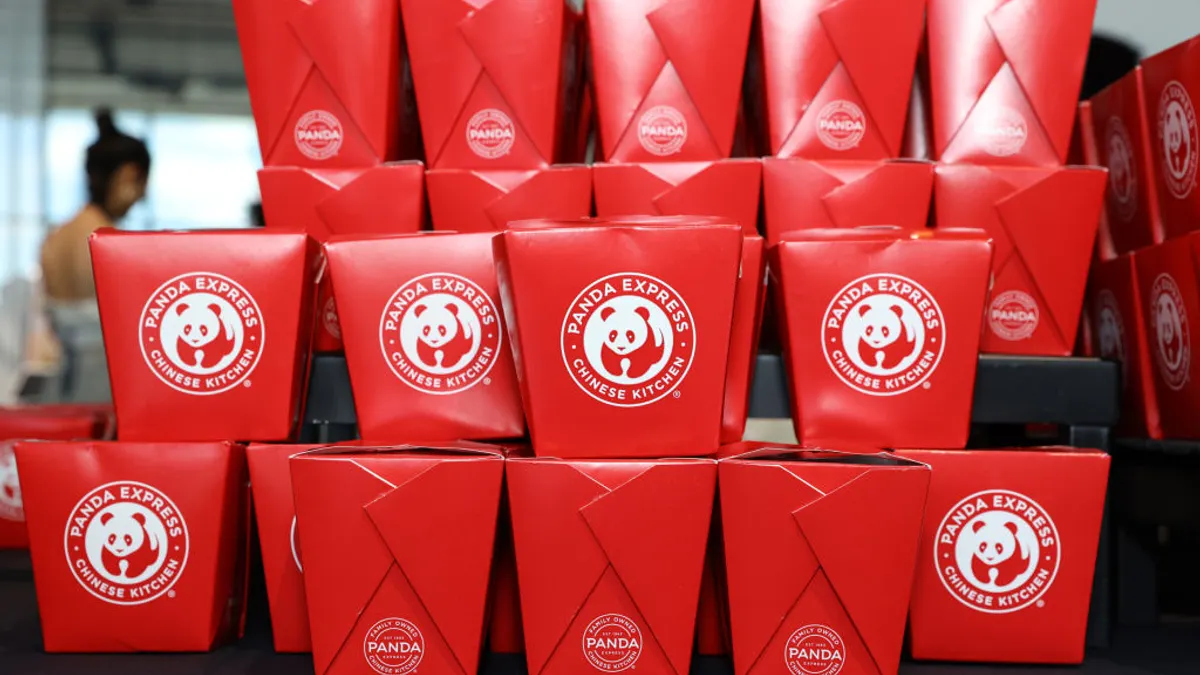
Panda Restaurant Group Chief Supply Chain Officer Roland Ornelas remembers when Panda Express, the group's American Chinese fast-casual restaurant chain, rolled out a new menu item every 18 months. Not anymore.

Today, that more leisurely pace has been reduced to just six months to lock in suppliers and pricing for the specialty ingredients behind the new dish that Panda Express is betting will keep customers from drifting to competitors.
"The role of the supply chain is to then go out and find suppliers that can scale to our demand," Ornelas said. "And a big part of our role is ensuring that we're bringing the right suppliers in partnership and in collaboration with our product innovation team."
To make that partnership work, Ornelas' team must constantly fine-tune sourcing and distribution, a complicated task given the size of Panda Express' supply chain. The network oversees $2 billion in annual spending and moves highly perishable meats, vegetables and spices through 284,000 deliveries each year to more than 2,500 restaurants — all but 120 in the United States, according to Ornelas.
“Our supply chain is really built around managing to a very short shelf life and fresh ingredients,” Ornelas said. For example, broccoli — one of Panda Express’ staple items — lasts only about 10 days from harvest to consumption. The company buys 33 million pounds of broccoli annually.
To ensure freshness, Panda Express relies on close coordination with its 26 third-party distribution centers, 21 of which are located in the U.S. These facilities order ingredients from suppliers and ship them directly to the restaurants, Ornelas said.
For now, all distribution centers sit within 150 miles of the restaurants they serve, though Ornelas would like to shorten that distance further. At the current range, Panda Express distributors deliver 95% of orders on time, and restaurants receive the exact ingredients ordered 99.8% of the time, he added.
Achieving those metrics requires both technology and precision planning. Supply chain managers receive daily operational updates, Ornelas said, and use optimization software to anticipate total ingredient demand, supplier locations and costs across all distribution centers.
"We're optimized in being able to get the lowest cost to our stores, utilizing all of the cost driver information that we have," Ornelas said, adding, "Panda has always been a very data-driven organization."
That data-driven approach will eventually lead to capturing deeper insights from second- and third-tier suppliers and integrating more international data into the analytics used for domestic operations, Ornelas said.
Looking ahead, Ornelas expects artificial intelligence to amplify Panda Express’ technology efforts as it is introduced into supply chain software. He believes AI will reveal patterns and opportunities not yet visible in existing datasets.
"I think that's where technology and AI are really going to help every business," he said. "It's seeing how supply chain data, marketing data and operational data can all come together."
For Panda Express, continuous improvement of the supply chain is essential to maintaining what it sees as its competitive edge: fresh ingredients and a steady flow of new menu items that retain and attract customers.
"The lifeblood of the restaurant industry is new items. You need something to speak about," Ornelas said, adding, "You have to really focus on that value to guests — but you also have to steal customers from your competitors."